
.png)
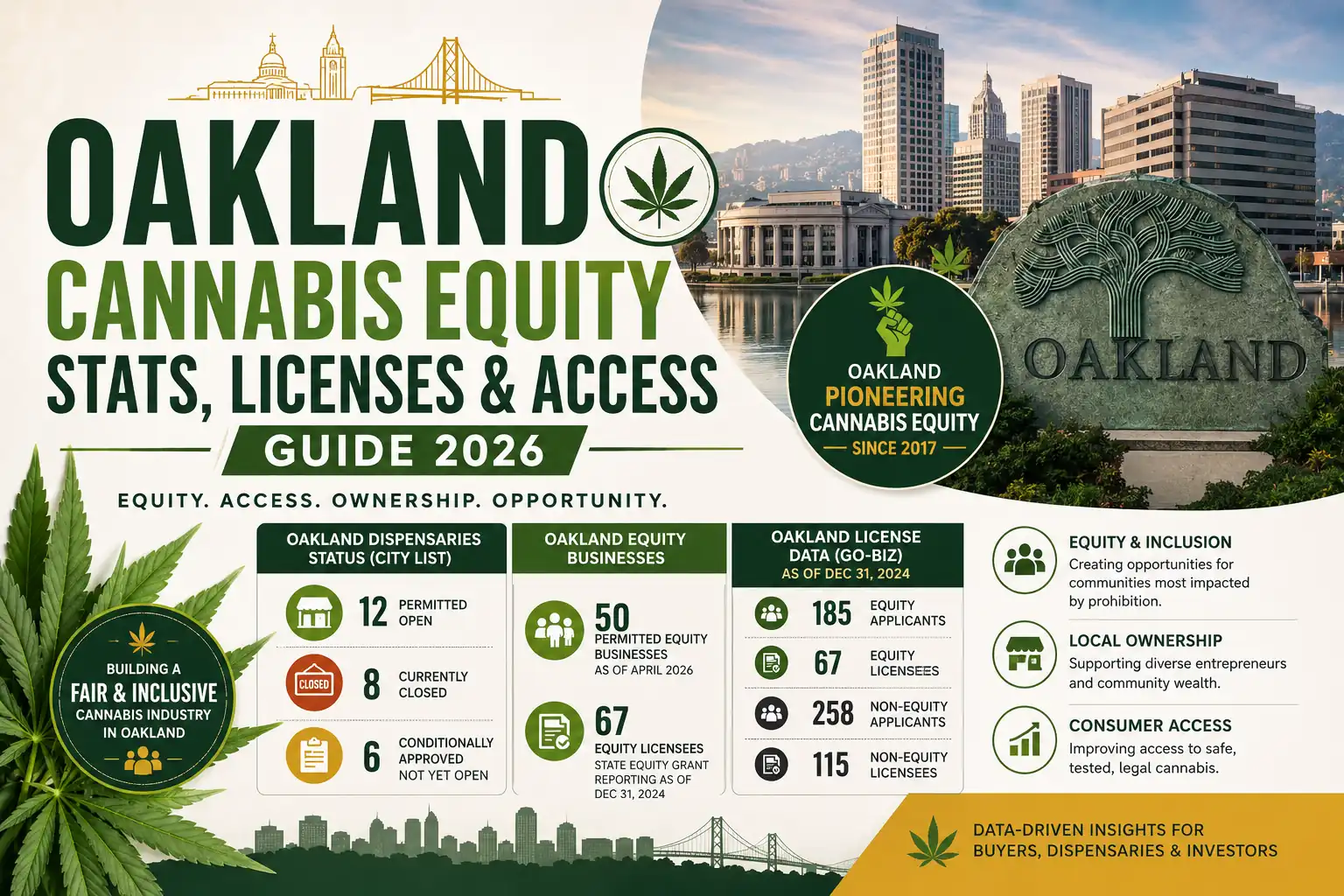
Oakland cannabis equity statistics tell a clear story: Oakland helped create the modern cannabis equity model, and the city still plays a major role in California’s legal market. The city launched its Cannabis Equity Program in 2017 to help people harmed by past cannabis enforcement enter the legal industry. As of April 2026, Oakland said it had 50 permitted Equity cannabis businesses, while state equity grant reporting listed 67 local equity licensees as of December 31, 2024.
Quick takeaways
- Oakland was the first U.S. city to launch a cannabis equity program, and it remains a key case study for local licensing, ownership, and consumer access.
- Oakland’s city list shows 12 permitted dispensaries currently open, 8 currently closed, and 6 conditionally approved but not yet open.
- GO-Biz reported 185 equity applicants, 67 equity licensees, 258 non-equity applicants, and 115 non-equity licensees in Oakland as of December 31, 2024.
What do Oakland cannabis equity statistics show?
The numbers show both progress and pressure. Oakland has a large equity licensing base compared with many California cities, but licenses alone do not guarantee long-term success. Operators still face high rent, taxes, security costs, competition, state compliance rules, and a tough California cannabis market.
The city’s equity program is designed to reduce barriers through fee waivers, technical help, business education, no-interest startup loans, grants, shared-use manufacturing support, and workforce development.
Here is the most useful snapshot.
Equity licenses table
GO-Biz also reported that Oakland received $1.83 million in grant expenditures during calendar year 2024 and assisted 32 local equity licensees through grants that year.
Why is Oakland important in cannabis equity?
Oakland matters because it did not treat equity as an afterthought. The city built equity into local licensing before many other cities had a model to copy.
Oakland says its program helps people negatively affected by the War on Drugs enter the cannabis industry and build local businesses. In 2026, the city also launched the Oakland Legendary Cannabis Certified Equity Label, a certification mark meant to help buyers identify city-verified equity businesses on packaging, marketing, and retail windows.
For cannabis consumers, this matters because a purchase can support local operators with real community roots. For sellers and dispensaries, it means equity is not only a licensing category. It can also be part of branding, trust, product education, and local identity.
Who qualifies for Oakland’s cannabis equity program?
Oakland’s eligibility rules focus on residency, income, and past cannabis enforcement impact.
According to the GO-Biz report, applicants must first:
- Reside in Oakland
- Have annual income at or below 80% of Oakland Area Median Income, adjusted for household size
Then applicants must also meet at least one of these conditions:
- Have lived for at least 10 of the last 20 years in the specified Oakland police beats
- Have been arrested after November 5, 1996, and convicted of a cannabis crime committed in Oakland
The city’s equity program page also explains that equity applicants may qualify for fee waivers plus technical and financial assistance, while general applicants are all other applicants. At least half of all permits must be issued to equity applicants.
How dense is Oakland’s dispensary market?
Dispensary density is a simple way to understand consumer access. It does not tell the whole story, but it helps show how many storefront options exist for residents and visitors.
Oakland’s permitted dispensary page lists 12 permitted dispensaries under the active permitted section. It also lists 8 currently closed dispensaries and 6 conditionally approved locations that are not yet open.
Oakland’s 2025 Census population estimate was 440,838. Using the city’s 12 open permitted dispensaries, Oakland has about 2.7 open city-listed dispensaries per 100,000 residents.
Dispensary density table
The DCC reports 4.27 retail licenses per 100,000 people statewide as of February 2026. This is not a perfect one-to-one comparison because Oakland’s number above uses city-listed open permitted dispensaries, while the DCC figure is based on state retail licenses. Still, it gives readers a useful access benchmark.
What does Oakland’s dispensary list show?
The city’s active permitted list includes well-known operators and neighborhood-serving shops. The list includes names such as Authentic 510 dba Stiiizy, Eco Cannabis, Harborside Health Center, Ivy Hill, Kanna, Oakanna, Ohana, Nug, Phytologie Wellness Center, Root’d In the 510, and Urbana Oakland.
For shoppers, that means Oakland still has a mix of large brands, local retailers, legacy names, and equity-linked operators. For sellers, it shows a competitive storefront market where brand trust, location, product mix, pricing, and service matter.
What should buyers check before visiting?
Before you shop, check:
- Store license and current status
- Online menu accuracy
- Product freshness
- THC and CBD levels
- Edible serving size
- Return or issue policy where allowed
- Pickup, parking, and payment options
- Whether the store supports Oakland equity operators
The California DCC says its license search tool is updated daily and can be used to verify licensed businesses, search for retailers, and file complaints. It also defines Active status as a license that allows the business to perform the commercial activity listed at the licensed location.
How does Oakland compare with Alameda County and California?
Oakland is only one city, but it has an outsized role in Alameda County’s cannabis economy and in California’s equity story.
Alameda County’s 2025 Census population estimate was 1,636,630, while Oakland’s estimate was 440,838. That means Oakland accounts for about 26.9% of Alameda County’s population.
The state also explains that cannabis business rules are local. Counties can set rules for unincorporated areas, while incorporated cities can set their own rules inside city limits. This is why Oakland’s rules can differ from Alameda County rules.
City and county comparison table
This comparison is important for dispensaries. A shop in Oakland is not only serving nearby residents. It may also serve commuters, visitors, and consumers from nearby areas with fewer legal storefront options.
What does ownership data show in Oakland?
Ownership data helps explain whether equity licensees are holding meaningful stakes in their businesses. GO-Biz reported 94 total equity-owned businesses from the City of Oakland. The ownership table shows that many equity licensees owned 50% or 100% of their businesses.
Ownership data table
This matters because equity can be weakened if applicants hold only symbolic ownership. Oakland’s reported ownership data shows a meaningful number of businesses with 100% equity ownership, especially among LLCs and corporations.
What do demographic statistics show about Oakland equity licensees?
The 2025 GO-Biz report includes voluntarily reported demographic data. It is important to read this carefully because some people declined to state information, and some values are marked NR.
Still, the data gives useful signals.
Equity licensee demographic snapshot
The same report shows 31 Black or African American local equity applicants and 15 Black or African American local equity licensees in Oakland. It also shows 17 equity applicants and 16 equity licensees reporting a prior cannabis-related conviction.
These Oakland cannabis equity statistics are useful for understanding participation, but they do not tell us whether each business is profitable, fully operating, or growing.
What does equity mean for cannabis consumers?
For consumers, equity is about more than a label. It can help you understand who benefits from the legal market.
When you choose a licensed Oakland dispensary or an equity-certified product, you may be supporting:
- Local ownership
- Operators affected by past cannabis enforcement
- Oakland-based cannabis jobs
- Legacy cannabis knowledge
- Community-rooted businesses
- A more diverse legal market
That said, buyers should still shop smart. Equity status should work alongside product quality, testing, service, price, and safety. The strongest equity brands win when consumers can trust both the mission and the product.
What does equity mean for dispensaries and sellers?
For sellers, equity can shape how products are sourced, displayed, promoted, and explained.
Dispensaries can support equity operators by:
- Carrying verified Oakland equity brands
- Training staff to explain the equity label
- Creating shelf tags for local equity products
- Featuring equity brands in email and loyalty campaigns
- Sharing founder stories in a respectful way
- Paying vendors on time
- Avoiding predatory contract terms
- Tracking sales by equity brand participation
The Oakland Legendary certification mark gives retailers a simple way to help buyers identify verified equity businesses. That can make equity easier to understand at the shelf, not just in policy documents.
Why do some equity businesses still struggle?
Equity licensing helps open the door. It does not remove every barrier.
Common challenges include:
- Startup capital
- Rent and buildout costs
- Security costs
- Insurance
- Tax pressure
- State and local compliance
- Payment processing problems
- Competition from unlicensed sellers
- Limited shelf access
- Retail consolidation
- Lower consumer spending in a mature market
Oakland’s own grant page shows the city continues to process grant support for equity applicants. In spring 2025, Oakland received its sixth GO-Biz grant for cannabis equity businesses in the amount of $2,074,369.75, with a grant period ending October 31, 2026. The city also stated it was not processing new loan applications due to a lack of funding.
That last point is important. Equity programs need capital, technical help, and market access, not only permits.
How should Oakland dispensaries use these statistics?
Dispensaries should use local equity data for better planning, not just marketing.
A practical store dashboard should track:
If the goal is real equity, then stores need to measure outcomes. A product cannot survive only because it is local. It needs visibility, fair placement, good inventory planning, and customer education.
What should sellers watch next in Oakland?
Oakland’s cannabis market is likely to keep changing. Sellers should watch:
- New openings from conditionally approved dispensaries
- Reopenings or permanent closures
- Oakland Legendary label adoption
- Equity grant disbursement updates
- Local tax and fee changes
- State license status changes
- Enforcement against unlicensed operators
- Customer demand for local and equity-owned brands
- California retail access changes
The state’s DCC says it has dashboards for licensing, harvest, sales, and track-and-trace information to help consumers, businesses, policymakers, local governments, and researchers understand the legal market.
FAQ
1. What do Oakland cannabis equity statistics include?
They include equity applicants, equity licensees, non-equity applicants, non-equity licensees, ownership percentages, demographic reporting, grant support, dispensary counts, and local access indicators.
2. How many equity cannabis businesses are in Oakland?
Oakland reported 50 permitted Equity cannabis businesses in its April 2026 announcement for the Oakland Legendary Cannabis Certified Equity Label. GO-Biz also reported 67 local equity licensees in Oakland as of December 31, 2024.
3. How many permitted dispensaries are open in Oakland?
Oakland’s permitted dispensary page lists 12 permitted dispensaries under its active permitted section. It also lists 8 currently closed dispensaries and 6 conditionally approved but not yet open.
4. What makes someone eligible for Oakland’s cannabis equity program?
Applicants must reside in Oakland, meet the income requirement, and meet at least one additional condition tied to long-term residence in specified Oakland police beats or a qualifying Oakland cannabis conviction.
5. Why do Oakland cannabis equity statistics matter for buyers?
They help buyers see who participates in the legal market and how consumer spending can support local equity operators. They also help shoppers choose licensed, regulated stores and products with more local context.
Final thoughts
Oakland’s cannabis equity system remains one of the most important local models in the country. The numbers show strong participation, meaningful equity ownership, and a growing effort to help consumers identify verified equity businesses.
They also show that access, funding, and market survival are still real challenges. For buyers, sellers, and dispensaries, the next step is simple: turn awareness into action by supporting licensed stores, trusted local brands, and fair business practices.
Ivy Hill supports a more informed Oakland cannabis community built around access, trust, and responsible adult use.
Oakland Cannabis Statistics 2026: A Deep Dive into Local Market Trends
Read More »
Oakland Legendary Cannabis: A Guide to the New Equity Certification
Read More »
Honoring Our Roots During Cannabis Equity Week
Read More ».png)

.png)

.png)